

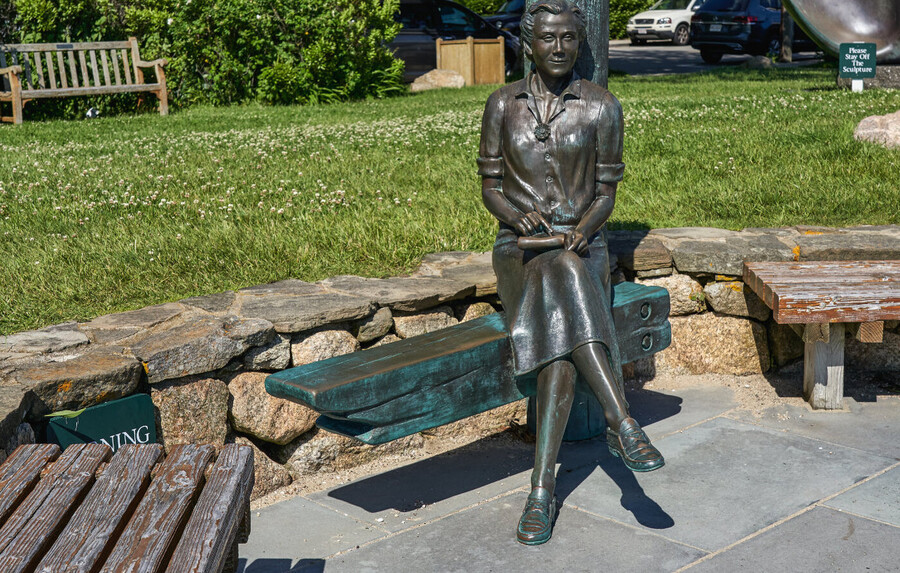

“There was a strange stillness,” wrote Rachel Carson in “A Fable For Tomorrow,” the first chapter of her 1962 book, Silent Spring:
“The birds, for example — where had they gone? Many people spoke of them, puzzled and disturbed. The feeding stations in the backyards were deserted. The few birds seen anywhere were moribund; they trembled violently and could not fly.
“It was a spring without voices. On the mornings that had once throbbed with the dawn chorus of robins, catbirds, doves, jays, wrens, and scores of other bird voices there was now no sound; only silence lay over the fields and woods and marsh.”
Throughout Silent Spring, scenes as vividly painted as this one are intertwined with explanations of scientific findings related to harms caused by pesticides.
Monsanto's Silent Spring parody
“For now spring came to America — an extremely lively spring,” reads a segment of “The Desolate Year,” an essay published in Monsanto Magazine only a few months after the publication of Silent Spring.
“Genus by genus, species by species, sub-species by innumerable sub-species, the insects emerged. Creeping and flying and crawling into the open, beginning in the southern tier of the states and progressing northward…
“Hard-pressed men of the US Department of Agriculture, besieged with pleas for help, could only issue advisories to rake and burn, to plant late or early, to seek the more resistant strains. But when insects and diseases took over anyway, there was no recourse.”
This essay, which reads as a parody due to its strikingly similar style to “A Fable for Tomorrow,” was one of the pesticide industry’s initial attempts to discredit Rachel Carson’s work.
Carson’s writing allowed her book to reach people from a wide variety of backgrounds. It also captured the interest of the pesticide industry and the press, who used it to frame her as overly emotional — and thus less competent.
Preemptive pushback
Prior to the publication of Silent Spring in 1962, Carson, a former aquatic biologist at the US Fish and Wildlife Service, was a best selling author whose most well-known books included The Sea Around Us and The Edge of the Sea.
In order to publicize Silent Spring before its release, three chapters of the book were published in the New Yorker. This partial release alerted industry to the implications of her book and pushback began before the book was fully released.
The National Agricultural Chemical Association (NACA) launched a public relations campaign to emphasize the safety of agricultural chemicals and the Velsicol Chemical Corporation (the manufacturer of the pesticides chlordane and heptachlor) threatened to sue Silent Spring’s publisher if they published the book.
Personal attacks
After Silent Spring was released, industry began to push back on the contents of the book by insulting Carson's character and competence.
In a 1962 New York Times article, P. Rothberg, the then president of the Montrose Chemical Corporation of California, was quoted to have said Carson wrote Silent Spring not “as a scientist but rather as a fanatic defender of the cult of the balance of nature.” In 1962, Montrose was the largest producer of DDT, the pesticide central to the book.
In 1963, a cartoon appeared on the cover of Farm Chemicals magazine which depicted three industry representatives testifying before a congressman. In the background, a witch flies by on her broom stick.
Carson was also criticised by various press outlets, which often spoke about her in ways that are particular to attacks on female scientists. A Time magazine article accused her of using “emotion-fanning words” and anticipated that scientists, physicians, and other "technically informed people” would view Carson’s work as “hysterically overemphatic.”
In a Chemical & Engineering News article titled “Silence, Miss Carson,” the author claims that Carson’s call to write the book was an emotional one and that “it seems that a call to write a book has completely outweighed any semblance of scientific objectivity.”
The media landscape surrounding Silent Spring was also influenced by individuals holding political influence — even those who were not explicitly tied to pesticide manufacturers. For example, Ezra Taft Benson, the Secretary of Agriculture under the Eisenhower administration, allegedly wondered publicly “why a spinster with no children was so concerned about genetics.”
Lasting impact
This barrage of personal attacks on Rachel Carson did not dampen the impact of Silent Spring, which sold over two million copies in its initial release. The book also caught the attention of the Kennedy Administration. The President’s Science Advisory Committee released a Pesticides Report in 1963 which recommended that:
“The appropriate Federal departments and agencies initiate programs of public education describing the use and the toxic nature of pesticides. Public literature and the experiences of panel members indicate that, until the publication of Silent Spring by Rachel Carson, people were generally unaware of the toxicity of pesticides. The government should present this information to the public in a way that will make it aware of the dangers while recognizing the value of pesticides.”
Almost a decade later, in 1972, the newly created EPA banned the general use of DDT. EPA has since banned or restricted the use of six main pesticides discussed in Silent Spring: DDT, chlordane, heptachlor, dieldrin, aldrin, and endrin. These six pesticides were also among the first 12 persistent organic pollutants (POPs) listed under the Stockholm Convention, a global treaty working to protect human health and the environment from POPs.
Unfortunately, Carson had been fighting breast cancer as she wrote Silent Spring and she passed away in 1964, too soon to see the extent of the impact of her work.
While DDT remains banned for use in the US to this day, pushback against Silent Spring never fully relented. For example, in 2012, The Cato Institute, a think-tank known for its messaging related to limited government, published a book titled Silent Spring at 50: The False Cries of Rachel Carson.
The lasting criticism of Rachel Carson does not begin to outweigh the prolonged positive impact of Silent Spring, which continues to inspire new generations to think critically about the impacts humans have on our environment, and to become engaged in working towards a healthier future.
This is the first in a series of articles highlighting the longstanding issue of corporate pressure on scientists in the environmental health field.
Camille Sytko worked for CHE as a Science Communications Intern. She is a recent graduate of UCLA, where she majored in Environmental Science and minored in Environmental Systems and Society.