

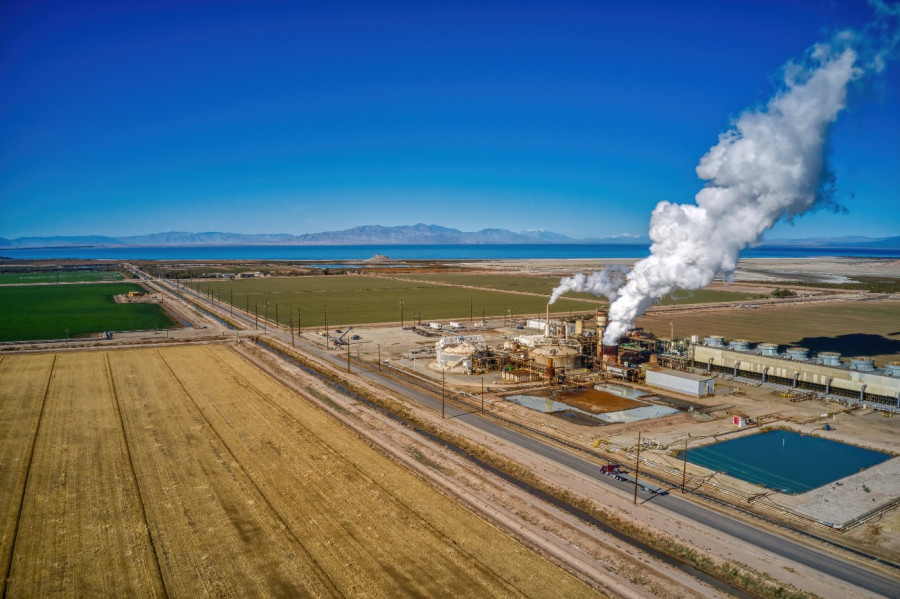

Southern California’s Imperial County is home to enough lithium to source 375 million electric vehicle batteries. Extraction of this resource is thus key to meeting the climate goal of reducing reliance on fossil fuels — but it may also put the health of the local community at risk.
Community groups are pushing back with legal action that is slowing the development of a major extraction project in what is now called “Lithium Valley.” The lawsuit shines light on the growing tension between climate-driven clean energy and transportation goals and community health in areas of resource extraction.
Legal challenge over air, water & waste
In December of 2023, the County of Imperial published the final state-level Environmental Impact Report (EIR) for Hell’s Kitchen LithiumCo 1, a Controlled Thermal Resource Holdings Inc (CTR) project that would extract a portion of the estimated 18 million metric tons of lithium under California’s Salton Sea. The EIR also evaluated the impact of the company's corresponding geothermal energy production project.
A few months later, two public interest non-profits, Comite Civico del Valle (CCV) and Earthworks, issued a joint petition claiming that the EIR did not sufficiently assess the project-specific and cumulative impacts of the operation, including impacts to air quality as an indirect impact of water usage.
Imperial Valley, now commonly referred to as Lithium Valley, is an arid region just over 100 miles east of San Diego. It is home to the southern end of the Salton Sea, a salinated lake that has historically been polluted from agricultural runoff containing pesticides, herbicides, and fertilizers. In their 2023 and 2025 reports examining the environmental health impacts of the proposed project, CCV and Earthworks explain how the project’s potential water demand could divert water from the Salton Sea, contributing to its recession and exposing nearby communities to legacy contaminants.
The suit also claimed that the county and CTR failed to conduct meaningful consultation with impacted Indigenous communities or good-faith analysis of measures to protect tribal cultural resources.
Limited water, high demand
Imperial Irrigation District (IID) is the public utility that distributes Colorado River water across the area. IID provided public comments on the EIR, noting that “the project's water supply needs to be conserved and is not readily available,” and that the project would divert water from other local uses such as agriculture. As Imperial Valley undergoes increased development due to its abundant geothermal and mineral resources, at least three other major development projects will be seeking to use Colorado River water from the IID. Despite the water agency’s comments noting that the EIR should consider these additional nearby projects, the final EIR neglected to consider this foreseeable water use.
The Salton Sea’s primary source of replenishment is agricultural runoff; increased water demand from this project (and others like it) could accelerate the Salton Sea’s existing crisis of rapid recession. This in turn would contribute to air quality risks as historical contaminants would become exposed and airborne. According to the Office of Environmental Health Hazard Assessment’s CalEnviroScreen, the communities nearest to the proposed lithium extraction (Brawley, Westmorland, and Calipatria) are currently between the 87th and 99th percentile in the state for rates of asthma.
In this context, a thorough analysis of cumulative impacts — and ensuring a commitment to mitigate them — is critical.
State protections in a changing national context
Hell’s Kitchen LithiumCo 1 is on pace to be one of the first lithium extraction operations in Imperial Valley. As such, the environmental considerations and mitigations it either commits to or avoids will set precedent for the projects that are sure to follow in this resource rich area.
“The history of natural resource extraction tells us to proceed with caution,” wrote Earthwork’s Jared Naimark. Comprehensive environmental reviews provide an avenue for resource extraction projects such as Hell’s Kitchen LithiumCo 1 to bring job opportunities to communities without increasing burdens from environmental health hazards.
As a result of a recent Executive Order, the Council on Environmental Quality’s (CEQ’s) federal environmental review implementing regulations were rescinded. Federal agencies can now make their own guidelines, and cumulative impact analysis is no longer required. Considering this upended federal regulatory landscape, holding state-level environmental reviews (which in California do require cumulative impact analysis) accountable to the highest standard is an increasingly important way to protect the health of communities living in areas of resource extraction.
What comes next?
In January 2025, Judge Jones of California Superior Court denied CCV and Earthwork’s request for a “writ of mandate” — a court order which would have made Imperial County’s approval of LithiumCo 1 void, pending the completion of a compliant EIR.
In September, CCV and Earthworks submitted an appeals brief to California’s 4th Appellate District Court (Battle Over Salton Sea Lithium Project Heads to Appeals Court). Imperial County officials filed a respondent’s brief on October 23rd, and have indicated their intention to proceed with the proposed project. Earthworks expects a decision on the appeal sometime in 2026.
As the project’s state-level environmental review continues to be litigated, federal review is underway and has been expedited through the federal designation of Lithium Co 1 as a FAST-41 project. FAST-41 projects receive assistance from federal officials as they navigate the environmental review process, resulting in decisions nearly 18 months faster than non FAST-41 projects.
Some media coverage surrounding the case has both amplified the importance of protecting environmental health in the region (New Report Raises Alarm Over Lithium Valley Development). Other stories have criticized the delays in economic development caused by prolonged legal actions (California’s dysfunction could squander Lithium Valley’s half-trillion-dollar potential), painting CCV and Earthworks as anti-industry.
In their 2025 report, CCV and Earthworks make clear that they have “no opposition to lithium development in principle, as long as there are reasonable environmental mitigations and public health protections for affected communities and tribes.” The hope of a successful transition away from fossil fuels is strengthened by the promise of projects such as Lithium Co 1. Yet for that transition to be just, resource extraction projects must not prioritize expedited timelines over thorough analysis of risks to local communities.
Camille Sytko worked for CHE as a Science Communications Intern. She is a recent graduate of UCLA, where she majored in Environmental Science and minored in Environmental Systems and Society.