

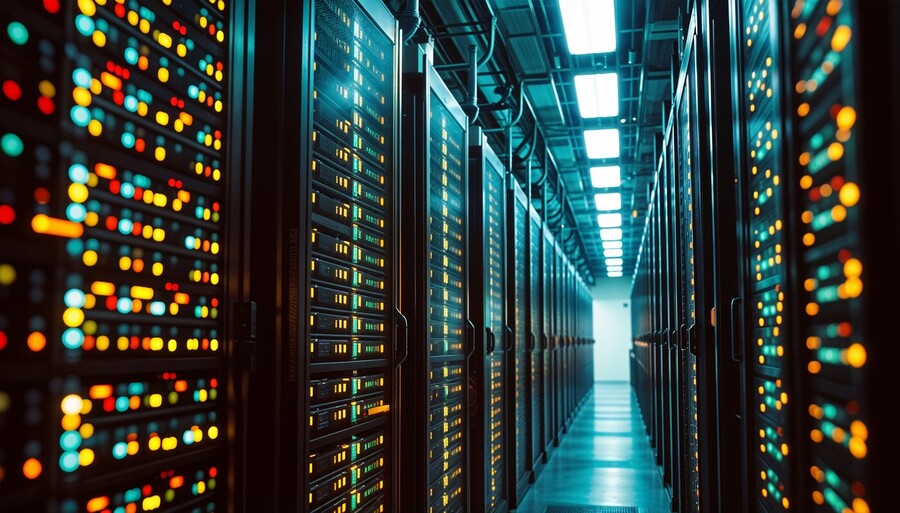

If you hear a hum outside, it might be your next-door data center’s fans whirring. Data centers are physical storage sites with the hardware used to power applications and services. Though you may be hearing about them more recently due to the surge of AI tools and companies investing in AI, data centers have been around since the 1940s.
Historically, data centers have been used to power a wide range of applications, starting with military computation in the 1950s to 1970s. From the 1980s to 1990s more data centers were needed to power the growing surge of personal computers. From the late 1990s to early 2000s was the internet boom, and companies began to share data centers to cut costs. Today, they house the infrastructure needed to power the website you are reading this on, cloud applications, and more recently, AI applications.
Generative AI has been around since the 1960s, starting in smaller scales with a program called ELIZA, which was an early form of chatbots. Generative AI has recently gained more traction due to its global widespread use, which is no longer concentrated among researchers and academics. While AI has its productive uses, its rapid growth has also created new challenges — including those associated with the surge in data center construction. These centers in turn have direct impacts on people and the environment in the communities where they operate.
Electricity & water consumption growing exponentially
Companies focused on creating AI services (such as OpenAI’s ChatGPT, Anthropic’s Claude, Google’s Gemini, and Microsoft’s Copilot) have started building more data centers to store their IT infrastructure and house their computational power. AI processes massive amounts of data for its training and output. As a result, AI data centers use much more electricity than traditional data centers.
According to the Pew Research Center, in 2024 “U.S. data centers consumed . . . more than 4% of the country’s total electricity. By 2030, this figure is projected to grow by 133%.” A little over ten years ago, data centers represented just 1.8% of total US electricity consumption.
Where is all this energy coming from? Data centers are mainly powered by local electrical grids, which has caused concerns for local communities as electricity bills rise. According to one recent report, 40% of data centers are powered by natural gas, 24% are powered by renewable energy, 20% are powered by nuclear energy, and 15% are powered by coal.
AI data center infrastructure can get very hot, which means the equipment needs fresh water to cool the servers and processor chips to avoid overheating. Experts at the Environmental Law Institute report that in 2014, data centers used 21.2 billion liters of water. This number more than tripled to 66 billion liters in 2023. Water shortages are becoming an issue for communities in the U.S. and across the globe. According to NASA, fresh water makes up about 3% of the Earth’s water supply, and only about 1% is available for human use. So this rapidly growing use of fresh water to cool data centers raises concerns.
Converting waste heat to “district heating?”
Though data centers use both water and fans to cool down equipment, they are often left with a tremendous amount of waste heat. Some towns and cities near data centers have begun to explore the benefits of a process known as district heating.
The concept of district heating dates back to 1877 and refers to leveraging a central source to distribute heat across several buildings. By using data centers’ waste heat as the central point, entire towns can have distributed heat. One recent article describes how a Finnish engineer began implementing district heating in 2009 using the wasted heat from a local data center. Now, the data center heats around 2,500 homes, supplying about ⅔ of the town’s heating needs. Microsoft now plans to build a data center in Espoo, the second largest town in Finland, which will heat around 100,000 homes.
Many other countries are beginning to plan for district heating supported by data centers. In a study published in Science Direct, researchers from Finland, China, and Singapore found that some countries are already mandating policies surrounding wasted heat:
“Germany's newly introduced Energy Efficiency Act mandates the reuse of ‘waste’ heat, with an ambitious target of achieving a 10% heat reuse rate by 2026 and a 20–30% rate by 2028 in DCs.”
Similar goals have been set by other European countries, including France, Sweden, Denmark and the Netherlands.
US lawmakers urge safeguards
Due to the rising costs of electricity in communities near data centers, US Senator Bernie Sanders and Representative Alexandria Ocasio-Cortez have introduced legislation to halt the construction of new centers until safeguards are in place to protect communities — and the impacts of AI products themselves are evaluated. These lawmakers contend that AI companies should be held accountable for rising costs of electricity and surging water consumption.
In addition to policy safeguards, more sustainable approaches to district heating and energy sources are being developed. Researchers are exploring novel ideas to improve the infrastructure for waste heating to better implement these systems. Some have also proposed ways to help data centers reduce their carbon emissions by using low carbon and renewable energy sources.
AI advancements are moving quickly. Decisions made now by companies and legislators will have a tremendous impact for years to come, both on communities where data centers are located and on how AI tools themselves are used.