Recently California’s Office of Environmental Health Hazard Assessment (OEHHA) published the results of a much-anticipated study assessing the health risks from exposure to tire crumb infill (also known as “crumb rubber”) in artificial turf fields. To learn more about the tire crumb health risk assessment, see Waste Tires in Artificial Turf Infill: Understanding OEHHA’s health risk assessment (Part 1).
OEHHA’s press release notes that the agency studied this material to inform California’s sustainability goals. When crumb rubber and synthetic turf comes into sustainability conversations, we should pause and consider what it means to substitute a synthetic product for natural grass, which Habitable has identified as preferable. What are the implications for the health of people and the environment throughout the product’s life cycle?
Plastic itself is a public health concern
Before addressing crumb rubber infill, it helps to step back and ask the question: what is synthetic turf? Synthetic turf is composed of plastic fibers — typically polypropylene, polyethylene, polyethylene terephthalate (PET), or nylon. These are attached to a primary and secondary backing, also made from plastic. The structure is similar to broadloom carpet that we find inside buildings, and it is around 70% plastic polymers by weight. This means that before any infill (such as tire crumb) is added, a standard NFL field would be covered in around 7.5 tons of plastic polymers — and more if shockpads are used beneath the turf. (To learn more, see this short video and this webinar.)
Is the generation of new plastic warranted so we can potentially squeeze in more games and practices per day on a field? That question matters because the generation of virgin plastic relies on oil and gas extraction, which has measurable impacts on public health. Moreover, research has shown that oil and gas wells are also disproportionately located near historically redlined communities with a high proportion of people of color, contributing to environmental injustices. In addition, the manufacture of plastic materials themselves has well-documented impacts on public health and the environment throughout the plastic life cycle.
An emerging concern for all plastic, including synthetic turf, is its contribution to micro- and macro-plastic pollution. For example, one recent study measured the presence of microplastics from synthetic turf fibers in river and sea water in the northwest Mediterranean. (To learn more about the study, see this short video and this webinar.) Microplastics can form at all stages of the plastic life cycle, from pre-production of materials (e.g., the formation of plastic pellets, flakes, and powders) to their use, to waste management (including recycling).
Data continue to emerge identifying microplastics as an environmental health concern. Regardless of the type of infill used, if we are going to have a serious conversation about sustainability, health, and synthetic turf, then we need to consider all of these impacts.
Synthetic turf does not contribute to a circular economy
Recycling has posed challenges for the synthetic turf industry. This lack of recycling should not be surprising. It is true of most plastic products because many practical challenges prevent the widespread recycling of plastic materials, as depicted in this diagram from Circular Flanders. The small percentage of plastic that is recycled still has a limited lifespan because plastic degrades when it is recycled.
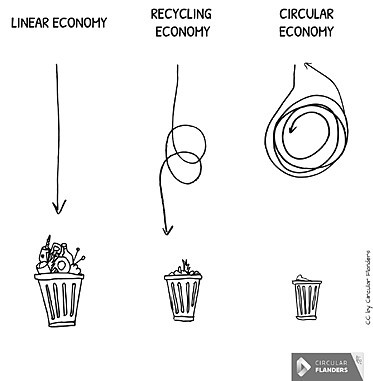
Depending on the recycling method, plastic usually can only be reused for one to four cycles. Most plastic recycling involves grinding up the plastic and using it as filler in new materials, but, to be functional, these materials still require new plastic to be incorporated into the final product. So-called chemical recycling technologies are highly inefficient. They contribute to environmental pollution and include turning plastic into fuel, which is not a circular solution.
Adding tire crumb infill to synthetic turf doesn’t keep it out of the environment
Now let’s turn our attention to the tire crumb, a type of plastic. After a synthetic turf field is laid, around 100 U.S. tons of tire crumb infill are added along with sand to weigh the carpet down and to hold the fibers upright, accounting for the vast majority of the weight of the turf. It is tempting to see this as a win for sustainability: that’s 100 tons of plastic that already existed, so we are avoiding a lot of the impacts from extraction and manufacturing noted above, assuming that some form of plastic infill was going to be added anyway. Moreover, these tires had to go somewhere, and now they have also not ended up in (or on) a landfill, and they are not being burned in a cement kiln.
However, the crumb rubber will eventually have to be disposed of. It can also be burned, carried away by shoes and clothing, or make its way into the environment through other means. While the exact amount may be up for debate, a substantial amount of crumb rubber is lost from fields each year. This crumb rubber breaks down in the environment, contributing to microplastic pollution.
We can do better
Keeping tires out of landfills is a good thing, but adding them to a field where they can be dispersed into the environment isn’t a solution. It is also problematic when we are generating several tons of new plastic polymer for each field that will receive tire-derived crumb rubber. It is important to remember that synthetic turf fields are not inevitable. We choose to make and install them. If we choose to invest in well maintained natural grass fields, then we don’t need to generate all of that new plastic. For more details on how some communities have done this, see this short video about Springfield, MA and this short video about other communities in Massachusetts.
The topic of tire crumb use on athletic fields is inseparable from the larger topic of synthetic turf. A product like synthetic turf should not be considered to be healthy when there are well-documented public health impacts facing communities from processes integral to its production, and when there are unavoidable or unresolved environmental health concerns later in its life cycle.
Synthetic turf is problematic, regardless of the type of infill, simply because it is plastic. Natural grass fields are not without their concerns, but it is possible to shift to more sustainable practices at any time. There are many on-ramps to sustainable management depending on budget. We need to continue identifying creative end-of-life solutions for tires, and investing in options that extend tire life, as much as we need to identify ways to sustainably manage all athletic fields. The best solutions will alleviate rather than put additional pressure on other planetary boundaries.
For more information on OEHHA’s assessment, see Waste Tires in Artificial Turf Infill (Part 1): Understanding OEHHA’s health risk assessment.
- Habitable. Turf Product Guidance. Informed. https://informed.habitablefuture.org/product-guidance/8-turf (accessed 2026-03-27).
- Union of Concerned Scientists. Environmental Impacts of Natural Gas. https://www.ucs.org/resources/environmental-impacts-natural-gas (accessed 2026-01-09); Physicians for Social Responsibility. Fueling Sickness: The Hidden Health Costs of Fossil Fuel Pollution; 2025. https://psr.org/issues/environment-health/fueling-sickness/; Garcia-Gonzales, D. A.; Shonkoff, S. B. C.; Hays, J.; Jerrett, M. Hazardous Air Pollutants Associated with Upstream Oil and Natural Gas Development: A Critical Synthesis of Current Peer-Reviewed Literature. Annual Review of Public Health 2019, 40 (1), 283–304. https://doi.org/10.1146/annurev-publhealth-040218-043715; Deziel, N. C. Environmental Injustice and Cumulative Environmental Burdens in Neighborhoods Near Oil and Gas Development: Los Angeles County, California, and Beyond. Am J Public Health 2023, 113 (11), 1173–1175. https://doi.org/10.2105/AJPH.2023.307422; Deziel, N. C.; Clark, C. J.; Casey, J. A.; Bell, M. L.; Plata, D. L.; Saiers, J. E. Assessing Exposure to Unconventional Oil and Gas Development: Strengths, Challenges, and Implications for Epidemiologic Research. Curr Envir Health Rpt 2022, 9 (3), 436–450. https://doi.org/10.1007/s40572-022-00358-4; Willis, M. D.; Campbell, E. J.; Selbe, S.; Koenig, M. R.; Gradus, J. L.; Nillni, Y. I.; Casey, J. A.; Deziel, N. C.; Hatch, E. E.; Wesselink, A. K.; Wise, L. A. Residential Proximity to Oil and Gas Development and Mental Health in a North American Preconception Cohort Study: 2013–2023. Am J Public Health 2024, 114 (9), 923–934. https://doi.org/10.2105/AJPH.2024.307730.
- Lane, H. M.; Morello-Frosch, R.; Marshall, J. D.; Apte, J. S. Historical Redlining Is Associated with Present-Day Air Pollution Disparities in U.S. Cities. Environ. Sci. Technol. Lett. 2022, 9 (4), 345–350. https://doi.org/10.1021/acs.estlett.1c01012; Berberian, A. G.; Rempel, J.; Depsky, N.; Bangia, K.; Wang, S.; Cushing, L. J. Race, Racism, and Drinking Water Contamination Risk From Oil and Gas Wells in Los Angeles County, 2020. Am J Public Health 2023, 113 (11), 1191–1200. https://doi.org/10.2105/AJPH.2023.307374; Chan, M.; Shamasunder, B.; Johnston, J. E. Social and Environmental Stressors of Urban Oil and Gas Facilities in Los Angeles County, California, 2020. Am J Public Health 2023, 113 (11), 1182–1190. https://doi.org/10.2105/AJPH.2023.307360; Donaghy, T.; Jiang, C. Fossil Fuel Racism: How Phasing Out Oil, Gas, and Coal Can Protect Communities; 2021. https://www.greenpeace.org/usa/reports/fossil-fuel-racism/ (accessed 2021-05-21).
- MacLeod, M.; Arp, H. P. H.; Tekman, M. B.; Jahnke, A. The Global Threat from Plastic Pollution. Science 2021, 373 (6550), 61–65. https://doi.org/10.1126/science.abg5433; Arp, H. P. H.; Kühnel, D.; Rummel, C.; MacLeod, M.; Potthoff, A.; Reichelt, S.; Rojo-Nieto, E.; Schmitt-Jansen, M.; Sonnenberg, J.; Toorman, E.; Jahnke, A. Weathering Plastics as a Planetary Boundary Threat: Exposure, Fate, and Hazards. Environ. Sci. Technol. 2021, 55 (11), 7246–7255. https://doi.org/10.1021/acs.est.1c01512; Tekman, M. B.; Walther, B. A.; Peter, C.; Gutow, L.; Bergmann, M. Impacts of Plastic Pollution in the Oceans on Marine Species, Biodiversity and Ecosystems; WWF Germany: Berlin, 2022. https://doi.org/10.5281/zenodo.5898684; Thompson, R. C.; Moore, C. J.; vom Saal, F. S.; Swan, S. H. Plastics, the Environment and Human Health: Current Consensus and Future Trends. Philosophical Transactions of the Royal Society B: Biological Sciences 2009, 364 (1526), 2153–2166. https://doi.org/10.1098/rstb.2009.0053; Landrigan, P. J.; Raps, H.; Cropper, M.; Bald, C.; Brunner, M.; Canonizado, E. M.; Charles, D.; Chiles, T. C.; Donohue, M. J.; Enck, J.; Fenichel, P.; Fleming, L. E.; Ferrier-Pages, C.; Fordham, R.; Gozt, A.; Griffin, C.; Hahn, M. E.; Haryanto, B.; Hixson, R.; Ianelli, H.; James, B. D.; Kumar, P.; Laborde, A.; Law, K. L.; Martin, K.; Mu, J.; Mulders, Y.; Mustapha, A.; Niu, J.; Pahl, S.; Park, Y.; Pedrotti, M.-L.; Pitt, J. A.; Ruchirawat, M.; Seewoo, B. J.; Spring, M.; Stegeman, J. J.; Suk, W.; Symeonides, C.; Takada, H.; Thompson, R. C.; Vicini, A.; Wang, Z.; Whitman, E.; Wirth, D.; Wolff, M.; Yousuf, A. K.; Dunlop, S. The Minderoo-Monaco Commission on Plastics and Human Health. Annals of Global Health 2023, 89 (1), 23. https://doi.org/10.5334/aogh.4056.
- de Haan, W. P.; Quintana, R.; Vilas, C.; Cózar, A.; Canals, M.; Uviedo, O.; Sanchez-Vidal, A. The Dark Side of Artificial Greening: Plastic Turfs as Widespread Pollutants of Aquatic Environments. Environmental Pollution 2023, 334, 122094. https://doi.org/10.1016/j.envpol.2023.122094.
- Thompson, R. C.; Courtene-Jones, W.; Boucher, J.; Pahl, S.; Raubenheimer, K.; Koelmans, A. A. Twenty Years of Microplastic Pollution Research—What Have We Learned? Science 2024, 386 (6720), eadl2746. https://doi.org/10.1126/science.adl2746.
- Monclús, L.; Arp, H. P. H.; Groh, K. J.; Faltynkova, A.; Løseth, M. E.; Muncke, J.; Wang, Z.; Wolf, R.; Zimmermann, L.; Wagner, M. Mapping the Chemical Complexity of Plastics. Nature 2025, 643 (8071), 349–355. https://doi.org/10.1038/s41586-025-09184-8; Villarrubia-Gómez, P.; Almroth, B. C.; Eriksen, M.; Ryberg, M.; Cornell, S. E. Plastics Pollution Exacerbates the Impacts of All Planetary Boundaries. One Earth 2024, 7 (12), 2119–2138. https://doi.org/10.1016/j.oneear.2024.10.017; Landrigan, P. J.; Dunlop, S.; Treskova, M.; Raps, H.; Symeonides, C.; Muncke, J.; Spring, M.; Stegeman, J.; Almroth, B. C.; Chiles, T. C.; Cropper, M.; Deeney, M.; Fuller, L.; Geyer, R.; Karasik, R.; Mafira, T.; Mangwiro, A.; Matias, D. M.; Mulders, Y.; Park, Y.; Velis, C. A.; Vermeulen, R.; Wagner, M.; Wang, Z.; Whitman, E. M.; Woodruff, T. J.; Rocklöv, J. The Lancet Countdown on Health and Plastics. The Lancet 2025, 406 (10507), 1044–1062. https://doi.org/10.1016/S0140-6736(25)01447-3; Trasande, L.; Krithivasan, R.; Park, K.; Obsekov, V.; Belliveau, M. Chemicals Used in Plastic Materials: An Estimate of the Attributable Disease Burden and Costs in the United States. Journal of the Endocrine Society 2024, 8 (2), bvad163. https://doi.org/10.1210/jendso/bvad163; Chartres, N.; Cooper, C. B.; Bland, G.; Pelch, K. E.; Gandhi, S. A.; BakenRa, A.; Woodruff, T. J. Effects of Microplastic Exposure on Human Digestive, Reproductive, and Respiratory Health: A Rapid Systematic Review. Environ. Sci. Technol. 2024. https://doi.org/10.1021/acs.est.3c09524.
- Lundstrom, M.; Wolfe, E.; FairWarning. The Dangerous Pileup of Artificial Turf. The Atlantic. December 19, 2019. https://www.theatlantic.com/science/archive/2019/12/artificial-turf-fields-are-piling-no-recycling-fix/603874/ (accessed 2026-04-02).
- Habitable. Designing Out Plastics: A Blueprint for Healthier Building Materials; 2025. https://habitablefuture.org/resources/designing-out-plastics-a-blueprint-for-healthier-building-materials/.
- Nihan Karali. The Technical Limits of Chemical Recycling, 2026. www.healthandenvironment.org/che-webinars/97112.
- Renee Sharp; Shannon Goff; Vivian Xu; Caroline Kim. More Recycling Lies: What the Plastics Industry Isn’t Telling You About “Chemical Recycling”; NRDC, 2025. https://www.nrdc.org/sites/default/files/2025-03/More_Recycling_Lies_IB_25-02-A_07_locked.pdf; Veena Singla. Chemical Recycling of Plastic and Health Concerns, 2026. https://www.healthandenvironment.org/che-webinars/97112.
- Bauer, B.; Egebæk, K.; Ane Kirstine, A. Environmentally Friendly Substitute Products for Rubber Granulates as Infill for Artificial Turf Fields; M–955; Norwegian Environmental Agency, 2017. https://www.miljodirektoratet.no/globalassets/publikasjoner/M955/M955.pdf; OEHHA. Synthetic Turf Study: Assessment of Health Risks from Exposure to Chemicals in Crumb Rubber Infill - Final Report; Office of Environmental Health Hazard Assessment, 2026. https://oehha.ca.gov/sites/default/files/media/2026-03/oehhaturffinal.pdf.
- In 2018 California reported using 15.8% of waste tires in-state as tire-derived fuel for cement kilns, and exporting 26.5% as tire-derived fuel to countries including Japan, Korea, and India. See CalRecycle. California Waste Tire Market Report 2018; DRRR-2019-1654; California Department of Resources Recycling and Recovery, 2019. https://www2.calrecycle.ca.gov/Docs/Publications/Details/1654.
- Eunomia Research & Consulting Ltd. Environmental Impact Study on Artificial Football Turf; FIFA, 2017. http://quality.fifa.com/media/1230/artificial_turf_recycling.pdf; Verschoor, A. J.; van Gelderen, A.; Hofstra, U. Fate of Recycled Tyre Granulate Used on Artificial Turf. Environ Sci Eur 2021, 33 (1), 27. https://doi.org/10.1186/s12302-021-00459-1.
- Villarrubia-Gómez, P.; Almroth, B. C.; Eriksen, M.; Ryberg, M.; Cornell, S. E. Plastics Pollution Exacerbates the Impacts of All Planetary Boundaries. One Earth 2024, 7 (12), 2119–2138. https://doi.org/10.1016/j.oneear.2024.10.017.
View All Footnotes
Ryan Johnson is a Senior Researcher for Habitable. He brings over a decade of experience from working in the regulatory and non-profit sectors to understand chemical hazards related to the built environment. He currently works with the Habitable team to generate guidance aimed at reducing the human and environmental health impacts of building materials.