

Industrial chemicals that can affect male and female reproductive function are widespread in our environment, and many of these chemicals are commonly used in plastics. Over the past few decades, a growing body of evidence has found that exposure to such chemicals is linked to many health concerns, such as infertility, cancer, and neurodevelopmental disorders.
A new documentary, The Plastic Detox, unfolds the science behind plastic chemicals and their health impacts, specifically fertility challenges. This documentary was guided by environmental and reproductive epidemiologist Dr. Shanna Swan. In a recent EDC Strategies Partnership webinar, Dr. Swan discussed the science behind the movie.
The intervention
For the documentary, Swan conducted a three-month intervention for five couples experiencing infertility. The goal of the intervention was to “lower daily exposure to plastic-related chemicals in hopes of better health markers, and ultimately, pregnancy.”
As Swan explained,
“I realized that a really impactful thing would be to actually track the journey of people who lower their exposure and who have concerns about fertility and reproductive health.”
The intervention originally included six couples who were experiencing infertility, although one couple dropped out. At the start and at six and 12 weeks, the couples’ urine was tested for metabolites of several bisphenols, parabens, and phthalates. Those chemicals were chosen because they are found in plastics, can be easily measured, and are known to be associated with impaired reproductive health. (In a future intervention, Swan hopes to also measure for pesticides.)
To start the intervention, Swan visited the couples’ homes to see firsthand what products they were using. “I walked through their house and pointed out things that they might want to get rid of.”
Each couple was guided on ways to reduce their exposure. They replaced many of their products with lower chemical alternatives (such as glass food containers and fragrance-free personal care products).
The intervention was successful at reducing exposures; by the end of the 12 weeks, the urine tests showed significant declines in the target chemicals.
Fertility
The intervention also measured fertility through sperm testing. Sperm measurements have been shown to correlate to male fertility. (Testing for fertility in women is more difficult than in men. Swan hopes that a future study will also be able to look at female fertility by testing hormone levels.)
At baseline, all five men had less than 40 million motile sperm count, which is considered subfertile:
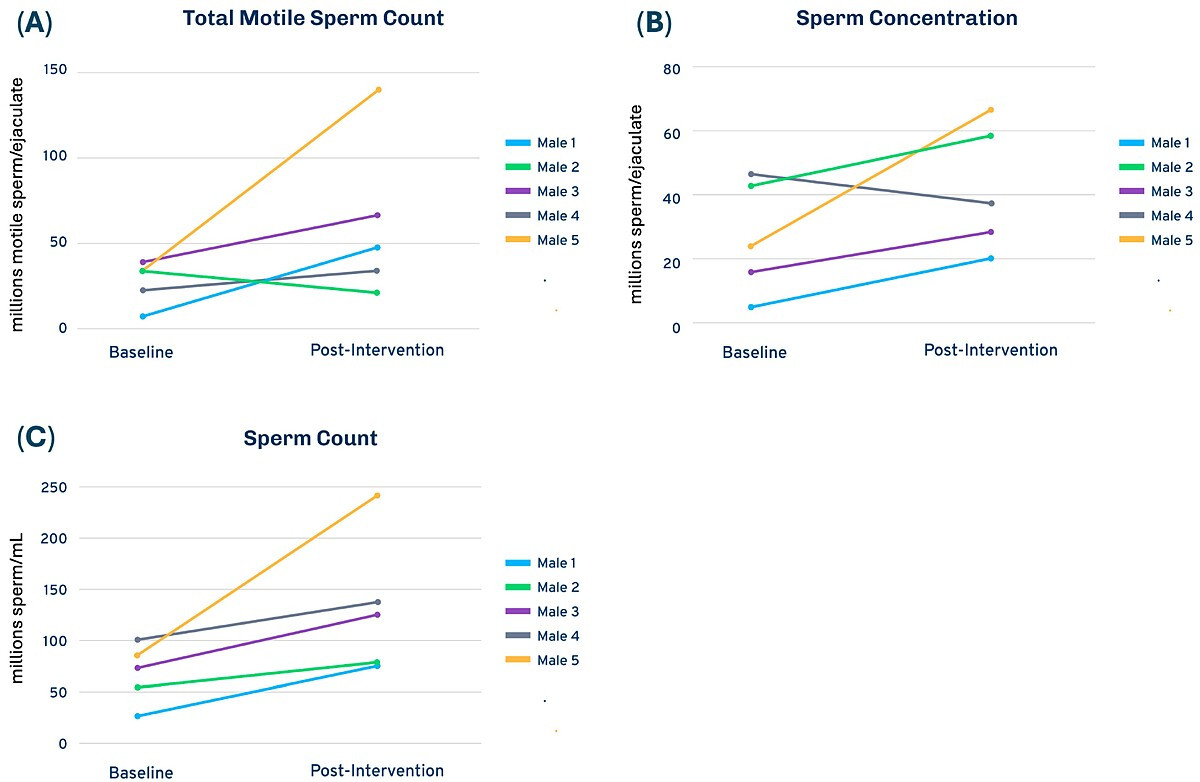
As shown is section (A) above, after the intervention three of the five men tested above the 40 million motile sperm count cutoff. Another sign that the intervention was successful — several of the couples have since had children.
Impacts on reproductive health
All of the chemicals tested for are endocrine disrupting chemicals (EDCs). EDCs can alter the hormonal signals that control and guide much of our growth and development, the way our organs function, and our ability to fight disease. EDCs are of particular concern for children and pregnant women.
Studies have shown that EDC exposure can potentially disrupt spermatogenesis, the process by which sperm cells are produced. Sperm cells take about 70 days to develop. The intervention was specifically designed to last three months so that benefits from lower EDC exposure in the men would have time to be reflected in the sperm counts.
EDCs are particularly risky for a pregnant person. Fetal cells divide rapidly and differentiate into the organs and systems. The development process is extremely sensitive to health impacts from endocrine disruption.
As Swan described, early in development, a fetus’ genital tract is not differentiated between male and female. The default tract is female. The cells that will become ovaries in females will become testes in males. Hormones, particularly testosterone, drive the process of male development. Phthalate exposure in the mother can cause testosterone levels to decrease. If the testosterone levels for the fetus are too low, then the differentiation process can be incomplete. Incomplete masculinization resulting from phthalate exposure is called phthalate syndrome.
Males with less complete masculinization exhibit smaller genitals, lower testosterone, and smaller anogenital distance (AGD - the distance between the anus and the genitals). Previous studies have shown that smaller AGD in males is a sign of less complete masculinization and phthalate syndrome. Further studies have shown that shorter AGD is correlated with lower male fertility.
This could partly explain rising rates of infertility and other reproductive health issues that have been measured in recent years. These include lower sperm counts, lower fertility rates for couples, and increased miscarriages.
“Reproductive function by many, many measures has been declining at about 1% per year.”
Swan also noted that fertility status can be a window into overall health. Increased infertility could be a warning about other health impacts caused by these chemicals. “People who have lower fertility, men and women, die younger...life expectancy is shorter if you're infertile.”
What we can do
Just as the couples in The Plastic Detox did, individual consumers can take many measures to lower their exposure to plastic chemicals and other EDCs. These include actions like avoiding fragrances and using glass food containers. One resource highlighted in the webinar is The Plastic Playbook, which includes 10 things everyone can do right away, as well as more in-depth advice.
While consumers can take action on their own, we also need better policies to protect everyone.
“As consumers, it is not our job to vet the safety of everything we buy. And this is forcing us to do that.”
Currently, the European Union has stronger policies than the US. In the EU, chemicals in products are regulated through REACH. The goal of REACH is to ensure that chemicals have been tested for safety before they’re put into the marketplace.
In the US, the Toxic Substances Control Act (TSCA) requires the EPA to identify and regulate chemicals that pose an “unreasonable risk” to people or the environment. Swan expressed hope that regulators could do a better job of implementing TSCA to protect people from EDCs in products. A strong global plastics treaty is another place where policy could help protect fertility and human health.
For more, see our webinar co-hosted by the EDC Strategies Partnership: Plastic, Chemicals & Infertility: What we know now.
This organizational blog was produced by CHE's Science Writer, Matt Lilley.