

In a recent webinar, Ryan Johnson, Senior Researcher at Habitable, and Dr. Winnie Courtene-Jones, Lecturer in Marine Pollution at Bangor University, UK discussed plastics in the built environment with a focus on artificial turf.
Johnson highlighted the pollution and hazardous exposures related to plastic building materials throughout their life cycle. He focused on artificial turf as a case study and presented information from Habitable’s Turf Product Guidance. This guidance provides information for building professionals and others.
Dr. Courtene-Jones discussed some of the many sources of microplastics, including from the built environment, and the health and environmental implications of macro- and micro-plastics.
Significant & growing plastic use
The built environment represents a large and often unrecognized use of plastic. After packaging, building and construction is the second largest application for plastic materials, accounting for 17% of use worldwide. Without interventions, plastic use in building and construction could nearly double by 2050.
Johnson highlighted that plastics used in building materials have human health and environmental impacts throughout the different stages of their life cycle. Examples include:
- Extraction and refining of fossil fuels used for plastic production disrupts ecosystems and contaminates air, water, and soil with hazardous substances.
- Chemical pollution from plastic manufacturing affects workers and fenceline communities.
- Workers can also be exposed to chemicals during product installation.
- Plastics can release chemicals during product use, through off-gassing, runoff, and other routes.
- Plastics recycling can result in the release of toxic chemicals, introduce toxic legacy chemicals into new products, and release microplastics.
"CHE Science Snippet" Webinar Preview
Life cycle impacts of plastics
A variety of types of polymer can be used in the carpet, infill, and shock pads of artificial turf. These polymers and the chemicals added to them are primarily derived from petrochemicals. To illustrate a chemical life cycle, Johnson explored the example of methylene diphenyl diisocyanate (MDI). MDI is commonly used to make polyurethanes, which can be used in artificial turf backings and shock pads.
“More than 90% of the inputs to this chemical, MDI, are hazardous to human health.”
These inputs include carcinogens, reproductive and developmental toxicants, potential endocrine disruptors, and respiratory sensitizers. MDI is itself a highly potent respiratory sensitizer. Incidents at facilities throughout the supply chain for MDI have injured workers and resulted in shelter-in-place orders for nearby communities.
Plastic pollution
Another concern about artificial turf and other plastic in the built environment is what happens when these products break down. Johnson discussed a study that quantified artificial turf fibers in samples of river and sea water in the NW Mediterranean. The study found that these fibers accounted for up to 15% of the larger plastic particles (>5 mm). In addition to the larger particles, about half of the artificial turf fibers found were microplastics (<5 mm). This study was discussed in a previous CHE Alaska webinar and in a Science Snippet with Dr. William de Haan.
Focusing on this issue, Dr. Courtene-Jones discussed ecological and human health concerns around microplastics. Due to their small size, microplastics can be ingested by a diversity of organisms. Ingestion occurs through dietary exposure, although inhalation and dermal contact can also be a source. For example, artificial turf materials that break down as people play or exercise on them could create airborne microplastic particles, leading to inhalation exposures.
There is emerging evidence that ingested microplastics can end up in a variety of tissues in the human body. Microplastics, and the chemicals they contain, can affect health through multiple mechanisms, including cellular damage, inflammation, oxidative stress, altered metabolism, and altered neurotransmission.
Courtene-Jones also illustrated the diverse sources of microplastics and the need for a suite of appropriate interventions to address these. She highlighted the importance of a precautionary approach focused on the reduced use of plastic:
“The most effective solution is to reduce plastic production, then to ensure that the plastics that are produced are safer and more sustainable than they are currently."
For athletic fields, that would mean investing in sustainably managed natural grass fields. While hazardous chemicals, such as pesticides, are sometimes used to care for and maintain natural grass fields, sustainable methods are available and can be adopted at any time.
Empowering decision makers
Johnson drew attention to resources that Habitable has developed to help decision makers choose the best athletic field surfaces for their communities. Habitable has published an overview of the different options for athletic fields, ranked based on their human health impacts through the product life cycle:
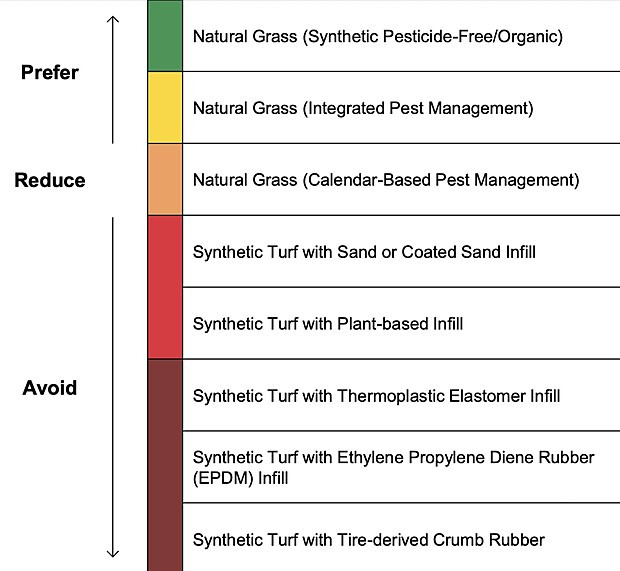
Johnson noted that conventionally managed natural grass can be converted to organic or sustainably managed natural grass at any time, whereas artificial turf, once installed, cannot be easily changed.
For more, see our webinar Plastics in the Built Environment: Considerations related to artificial turf. Other recent webinars that presented issues around artificial turf include Artificial Turf: Research on Plastic Pollution, PFAS & Health Concerns and Environmental Health Impacts of Synthetic Turf and Safer Alternatives.
For other blog posts related to artificial turf and playgrounds, see:
- Playing on Plastic: Artificial turf hazards and safer alternatives
- 6PPD in Tires: A concern for playgrounds, artificial turf, and more
- Playground Surfacing: Fun & safety without toxic chemicals
- Forever Chemicals in Artificial Turf: Understanding PFAS testing
This organizational blog was produced by CHE's Science Writer, Matt Lilley.